
August 31, 2026 · North Rose, New York
New evidence of alleged criminal cruelty at Marshall BioResources
is now in the hands of New York authorities.
A criminal referral prepared by former federal prosecutor Bonnie Klapper, on behalf of the Coalition to Save the Marshall Dogs, asks Wayne County District Attorney Christine Callanan and Wayne County Sheriff Robert Milby to open an immediate criminal investigation into Marshall BioResources and, on confirming the violations it describes, to prosecute. The full letter and its exhibits are published below.
What happened
Evidence was submitted to New York authorities.
The allegations
What the evidence describes.
Improper killings
Barbiturate injected into the abdomen of conscious dogs
The referral alleges that a whistleblower who worked at Marshall was assigned to kill dogs by lethal injection, frequently alone and with no veterinarian present, injecting the solution directly into the abdomen. The dogs were fully conscious and had been given no sedative or anesthetic. According to the whistleblower they did not die quickly or quietly: they screamed, thrashed, and struggled in what appeared to be extreme pain, in the whistleblower’s words as if they were being “burned alive from the inside.” One dog who could not be muzzled was held down by a supervisor’s foot on his neck so the injection could be given.
A death during “mask” training
A dog died on the table
The referral describes inhalation “mask” training on a five-day schedule, escalating from five minutes in a harness to fifteen minutes with a tight-fitting mask sealed over the snout. One dog urinated and defecated in panic, thrashed and rolled — the whistleblower called it an “alligator roll” — and became tangled in the harness. The whistleblower tried to remove the mask; the dog died on the table.
Violent handling
To move thousands of dogs quickly, the referral alleges, employees threw them into transport cages “like a frisbee,” and the dogs’ heads snapped against the backs of the cages.
Concealment from inspectors
According to the whistleblower, Marshall usually had advance notice of USDA inspections, employees would “panic clean” the facility before inspectors arrived, and the mask training was not performed while inspectors were present.
Puppies smothered in food pans
In buildings with barely any heat, the referral alleges, puppies would lie down in the warm wet-food pans to stay warm and were smothered or suffocated in them. The veterinary expert report records a photograph taken inside the facility showing a dead puppy in a metal feeding pan encrusted with caked food.
Healthy dogs killed for appearance or grade
The referral alleges that many of the dogs the whistleblower was directed to kill were healthy — culled for traits with no bearing on health, such as blue eyes or a significantly kinked tail, or because a mother dog was “done being bred.” The bodies were bagged and taken to an incinerator, where the whistleblower saw them stacked in piles, on at least one occasion taller than the whistleblower, who is about five feet nine.
The facility
Photographs from the evidence.
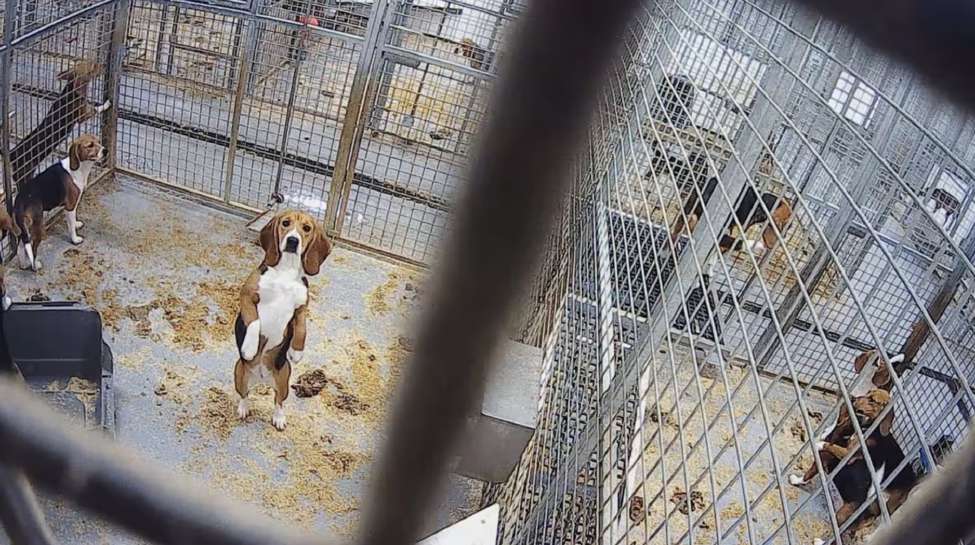
Two of the photographs that accompany the referral, both published with Wayne Hsiung’s account of the submission.

A beagle at the bars of a kennel run
The photograph the referral opens with.
Adjoining kennel runs
Dogs in neighboring runs, photographed through the fencing.
The ask
What the authorities are being asked to do.
NY AGM § 353
Cruelty to animals
The principal cruelty offense: torturing, unjustifiably injuring, or killing an animal is a class A misdemeanor.
NY AGM § 353-a
Aggravated cruelty (“Buster’s Law”)
A felony when a companion animal is killed with no justifiable purpose and in a manner intended to cause extreme pain, or that is depraved or sadistic.
NY AGM § 356
Neglect of confined animals
A misdemeanor to confine an animal and then fail to supply it with good and wholesome air, food, shelter, and water.
The two offices
The offices being asked to act.
The referral is addressed to the Wayne County District Attorney and the Wayne County Sheriff.

Christine Callanan
District Attorney, Wayne County, New York — the office the referral is addressed to, with jurisdiction over the North Rose facility. Official portrait: Wayne County District Attorney’s Office.

Letitia James
Attorney General, State of New York — statewide authority to investigate and to bring an action against a company of this size. Official portrait: Office of the New York State Attorney General.
The documents
The referral letter and exhibits.
Take action
Ask New York to act on the evidence.
District Attorney Christine Callanan and Attorney General Letitia James both have the authority to move today. Our action portal has the contact information and everything you need to make the ask.